This zone is designated to protect a high-quality living environment for low-rise housing. It typically features neighborhoods centered around detached houses and is considered the “most strictly regulated yet best-quality” residential area. While elementary/junior high schools and small home-based shops are permitted, large-scale commercial facilities and office buildings are prohibited.
1. Regulations Affecting Building Volume: Height, Building Coverage, and Floor Area Ratio
In these zones, strict limits are set to preserve a spacious and open streetscape.
(1) Height Limits (Absolute Height)
The maximum height is restricted to 10m or 12m (approx. 33–39 ft) . In addition, the 12-meter height limit is established by local ordinances. Consequently, the area primarily consists of 2-story houses, with some 3-story buildings depending on conditions.
(2) Building Coverage Ratio and Floor Area Ratio
This zone has Building Coverage Ratio is 30–60%, and Floor Area Ratio is 50–200%.
These figures are lower compared to other zones. Since the “buildable area” relative to the land size is limited, the benefit is that houses are spaced further apart, ensuring ample sunlight and ventilation.
2. Slant Line Restrictions (Setback Regulations)
To ensure open space between buildings and guarantee sunlight and natural light, there are “slant line” rules that effectively “slice” the building’s shape diagonally.
(1) Road Slant Line Restriction
This limits the height of the building based on the width of the front road to ensure light and air reach the road and the houses opposite.
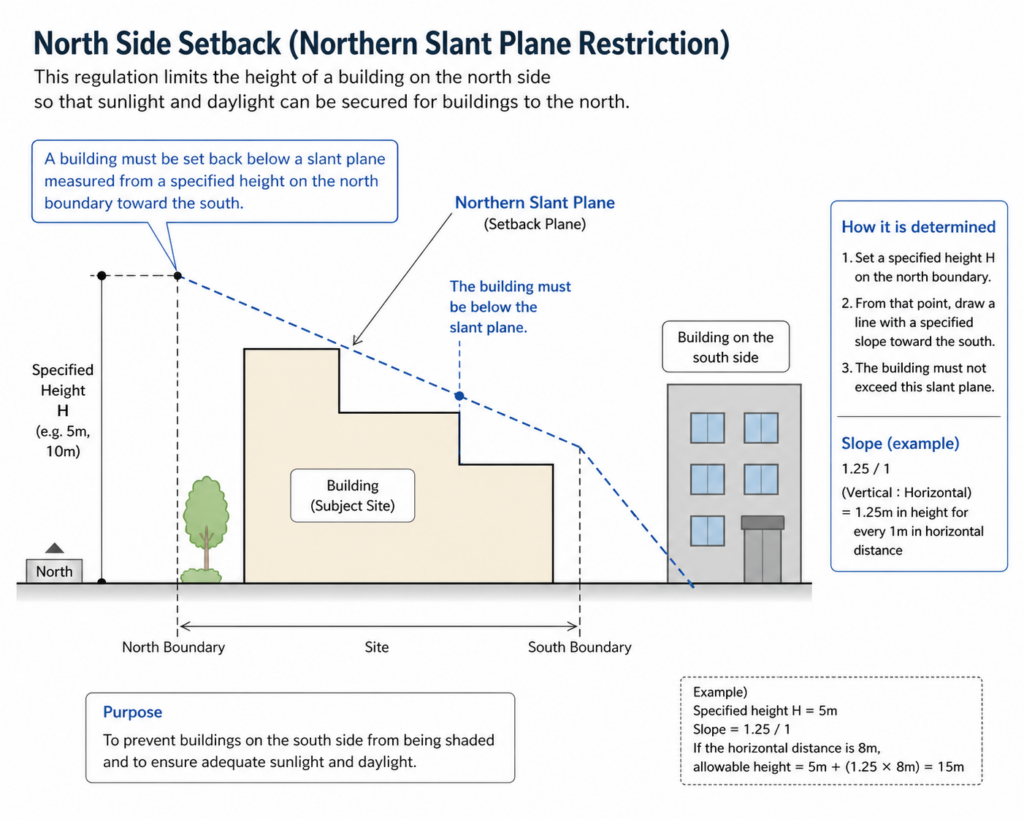
(2) North-Side Slant Line Restriction
This protects the sunlight of the neighbor to the north. Since Japanese home design prioritizes southern exposure, houses in these zones often have roofs clipped at an angle to avoid casting shadows on northern neighbors.
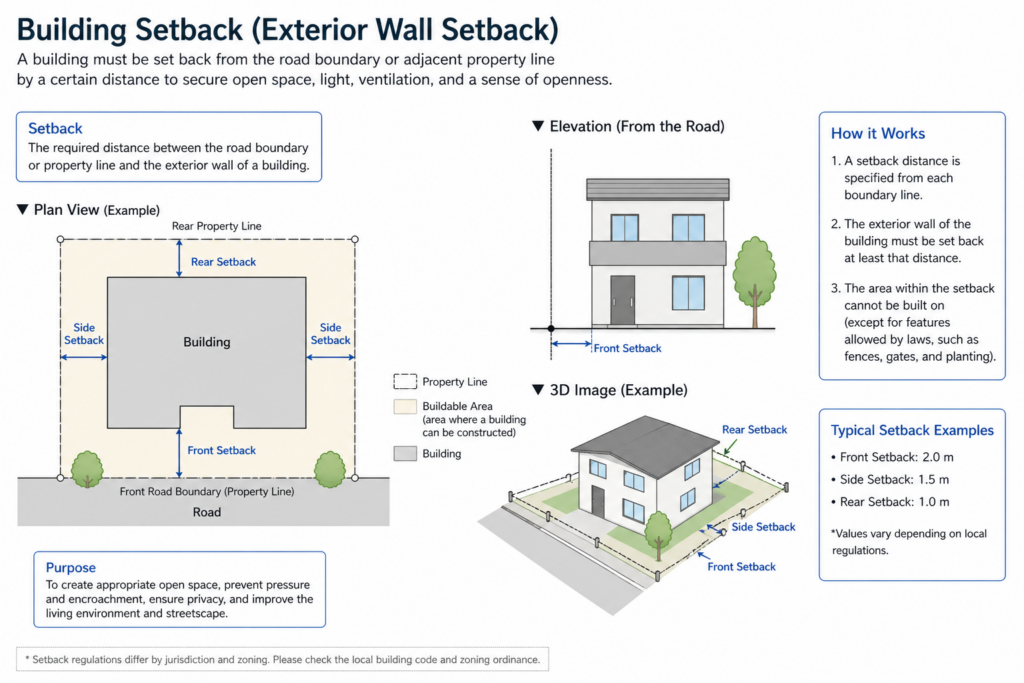
(3) “Wall Setbacks” for Extra Space
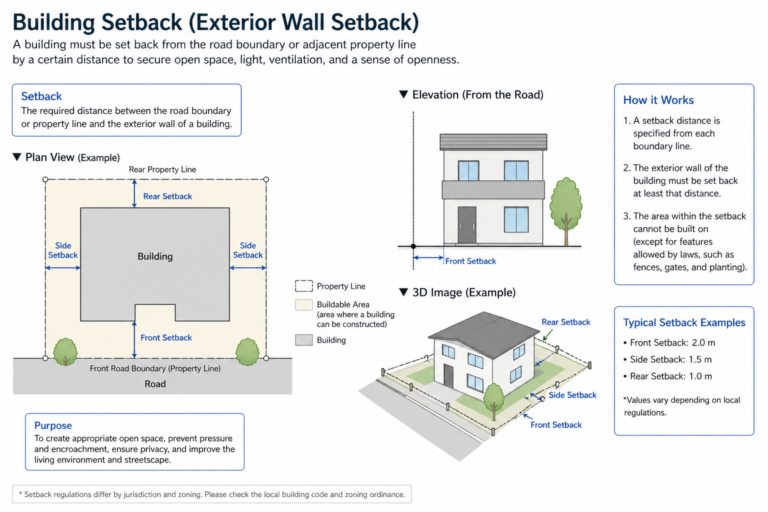
A unique rule for this zone is the requirement to keep the exterior walls 1m or 1.5m away from the property boundary. This prevents houses from being built right up against each other, maintaining a superior living environment in terms of both fire safety and privacy.
3. Permitted Facilities (Land Use Restrictions)
While primarily a “place to live,” home-based shops or offices are allowed if they meet specific criteria (the non-residential area must be under 50m² and less than half of the total floor area).
Permitted: Home-based bakeries, cafes, hair salons, cram schools, clinics, nurseries, elementary/junior high schools, libraries, shrines, and temples.
Prohibited: High schools, universities, standalone stores (like convenience stores), and hotels. While the environment is quiet, it can be less convenient for daily life, often requiring a walk to do grocery shopping.
4. Other restrictions
Depending on the specific location, there may be additional regulations such as District Plans, Building Agreements, or Landscape Ordinances. These can restrict not only the height and volume of a building but also its architectural design and color. I will explain these in a separate post.