Introducetion
Zoning in Japan refers to a system that regulates what kinds of buildings can be constructed in specific areas.
As explained in the previous section, these zones are broadly categorized into three types:
- Residential
- Commercial
- Industrial
In total, there are 13 zoning categories.
It’s important to understand that “zoning” is not the name of a specific place.
Rather, it is a collective term for these 13 different land-use categories.
1. What Does Zoning Control?
Each zoning category clearly defines what can and cannot be built.
This includes:
- Types of buildings allowed (e.g., houses, shops, factories)
- Types of buildings not allowed
- Building coverage ratio (how much of the land can be built on)
- Floor area ratio (total floor space limits)
- Height restrictions
Because of these rules, you can determine in advance what kind of development is possible on a given piece of land.
2. A Simple Guide to the 13 Zoning Categories in Japan
Japan has 13 zoning categories, but you don’t need to memorize all of them at once.
The easiest way to understand them is to group them into three types:
- 🏠 Residential Zones (8 types) No.1~No.8
- 🏬 Commercial Zones (2 types) No.9~No.10
- 🏭 Industrial Zones (3 types) No.11~ No.13
How to Understand Zoning (The Simple Way)
Instead of memorizing details, focus on these three principles:
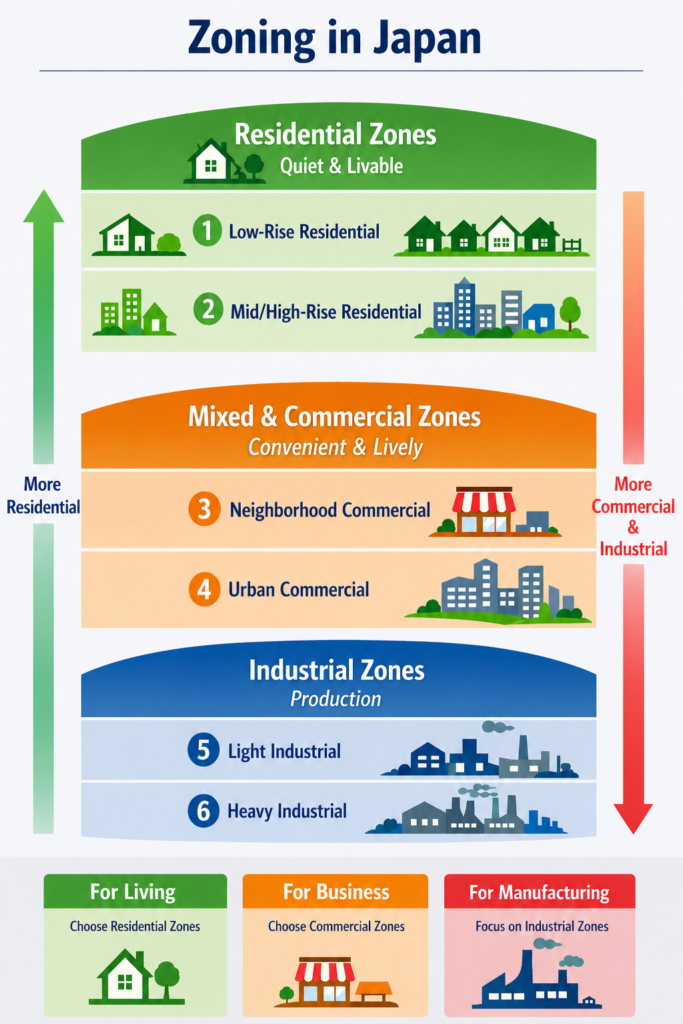
1. The higher you go, the more residential it is
Zones at the top (1–4) are designed to protect living environments.
→ Quiet, stable, and ideal for residential life
2. The middle is a mix of living and convenience
Zones in the middle (5–10) combine residential and commercial uses.
→ Balanced areas with both livability and convenience
3. The lower you go, the more industrial it becomes
Zones at the bottom (11–13) are focused on industry.
→ Suitable for business and production, less ideal for living
▼ Zoning Categories at a Glance
| No. | Zone Name | Main Characteristics | Key Point |
|---|---|---|---|
| 1 | Low-Rise Residential Zone (Category I) | Low-rise housing Residential Properties with limited commercial use (under 50㎡, <50%) | Strictest residential area |
| 2 | Low-Rise Residential Zone (Category II) | Housing Retail and dining establishments up to 150㎡ | Limited commercial use allowed |
| 3 | Mid/High-Rise Residential Zone (Category I) | Apartments + hospitals, universities, small shops (up to 500㎡) | More daily facilities |
| 4 | Mid/High-Rise Residential Zone (Category II) | Apartments + shops/offices (up to 1,500㎡) | Highly convenient residential area |
| 5 | General Residential Zone (Category I) | Housing + shops/hotels (up to 3,000㎡) | Wider range of uses |
| 6 | General Residential Zone (Category II) | Housing + shops and entertainment (e.g., karaoke) | Allows more activity |
| 7 | Rural Residential Zone | Farmland + low-rise housing | Balance between agriculture and living |
| 8 | Quasi-Residential Zone | Along major roads + car-related businesses | Roadside commercial type |
| 9 | Neighborhood Commercial Zone | Daily shopping areas | Residential + local shopping streets |
| 10 | Commercial Zone | City centers and downtown areas | Very flexible use |
| 11 | Quasi-Industrial Zone | Light industry + residential mix | Balanced mixed-use area |
| 12 | Industrial Zone | Factories allowed (few restrictions) | Housing allowed, but no schools |
| 13 | Exclusive Industrial Zone | Industrial use only | No housing or commercial use |
4. Why Zoning Matters in Real Estate
Zoning has a major impact on how land can be used and its overall value.
For example:
Can you build only a house?
Can you open a shop or cafe?
Can you construct a large building?
All of these depend on the zoning designation. That’s why checking the zoning classification is essential in any real estate transaction in Japan.
Practical Tips for Real Estate Decisions
When evaluating zoning, keep these simple guidelines in mind:
- For living → Choose low-rise or mid/high-rise residential zones
- For running a business → Look for neighborhood commercial or commercial zones
- For long-term stability → Be cautious with industrial zones
▼ Zoning image